Horse jumping training
Horse jumping training exercise
This exercise is a fantastic all-rounder for riders looking to sharpen their skills and prepare their horses for competition. It combines several key elements that will challenge both you and your horse, making it perfect for your regular horse jumping training routine. With just six jumps, you can work on a wide range of essential skills without overloading your horse.
The layout is designed to improve your reaction time and help you get your horse balanced and back under control quickly after landing. This is a crucial part of building adjustability, rhythm, and confidence — all of which carry over directly into your competition rounds.
The course includes a few carefully planned drills that focus on turnbacks and tight turns. These exercises are excellent for improving your accuracy and timing, both of which are vital when walking technical courses. You’ll also find a variety of related distances built into the track. These allow you to practice adjusting your canter stride, teaching both horse and rider to make the necessary changes for different situations.
A double combination is included as well, which is always helpful to school before heading off to a show. Combinations test your rhythm, straightness, and control — key ingredients for a successful round in the ring.
If you’re looking for a simple but highly effective way to add variety to your horse jumping training, this exercise delivers everything you need in a fun, compact format.
Watch the video of this exercise below.
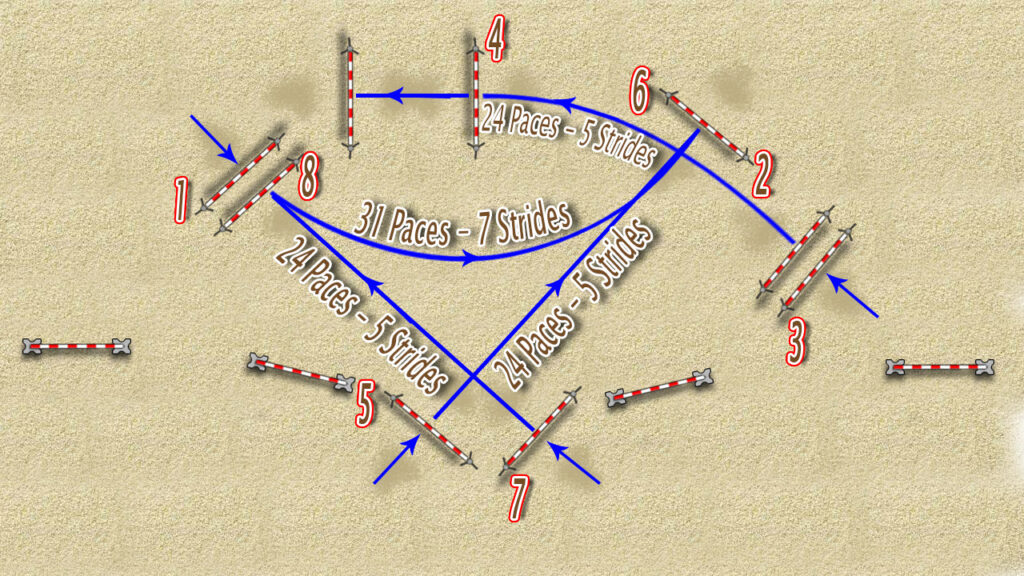
How to set this horse jumping training exercise up.
This is a nice, simple setup — quick to build but with enough technical details to keep you sharp. Just pay attention to the related distances, as they’re key to how the course rides.
First Line:
Start with an oxer, followed by five strides to a one-stride double of uprights.
- From the oxer to the first upright of the double, measure 24 paces, which gives you the correct five-stride distance.
- The one-stride double walks the standard 8 paces between the two uprights.
Second Line – Curving Related Distance:
Next, set up a curved line from an oxer to a vertical.
- This rides in seven strides, but because curving lines often ride a little long, build it one pace shorter than normal.
- So, measure 31 paces from the oxer to the vertical.
Third Line – Vertical to Vertical:
From the vertical you just set up, measure 24 paces straight to another vertical.
- This gives you a standard five-stride line.
Final Line – Vertical to Oxer:
Finally, set up a vertical 24 paces away from your starting oxer, making another five-stride line.
Warm-up Cavalettis:
Place two cavalettis on either side of your arena for your warm-up.
Then, place two more cavalettis at angles next to the two verticals for some extra precision work.
And that’s it — your course is ready!