Horse jumping how to train straightness
Horse Jumping How To: Train Your Horse to Jump Straight
One of the most important things you can work on with your horse is straightness — and yet, it’s something many riders overlook. Recently, someone asked me for a horse jumping how to exercise specifically for straightness. At first, I thought my horses were already quite straight, but I was happy to demonstrate the exercise anyway.
I like to use guide poles on the ground to help with this. The poles create a clear lane that helps both horse and rider stay straight on the approach, over the jump, and on the landing. What I found interesting is that, even though I thought my horses jumped straight, the guide poles revealed that they drifted more than I realised. It was a good reminder that exercises like this are always worth doing — no matter how experienced you or your horse may be.
Straightness isn’t just about neatness — it directly affects your horse’s power and jumping technique. A horse that jumps straight pushes evenly off both hind legs, which means more power, better balance, and a more controlled jump. Crooked approaches, on the other hand, can lead to poles down or even long-term issues.
In this horse jumping how to, the goal is simple: your horse must travel in a straight line to the jump, jump straight over the fence, and canter away straight. It sounds easy, but it’s surprisingly revealing. Give it a try — your horse’s power and balance will thank you.
Watch the video of this ‘Horse jumping how to’ below for all the details.
How to set it up.
This is a simple setup, but you will need a few extra poles to use as tramlines on the ground. You don’t have to set up the whole exercise — feel free to pick just one or two lines to practice if you prefer.
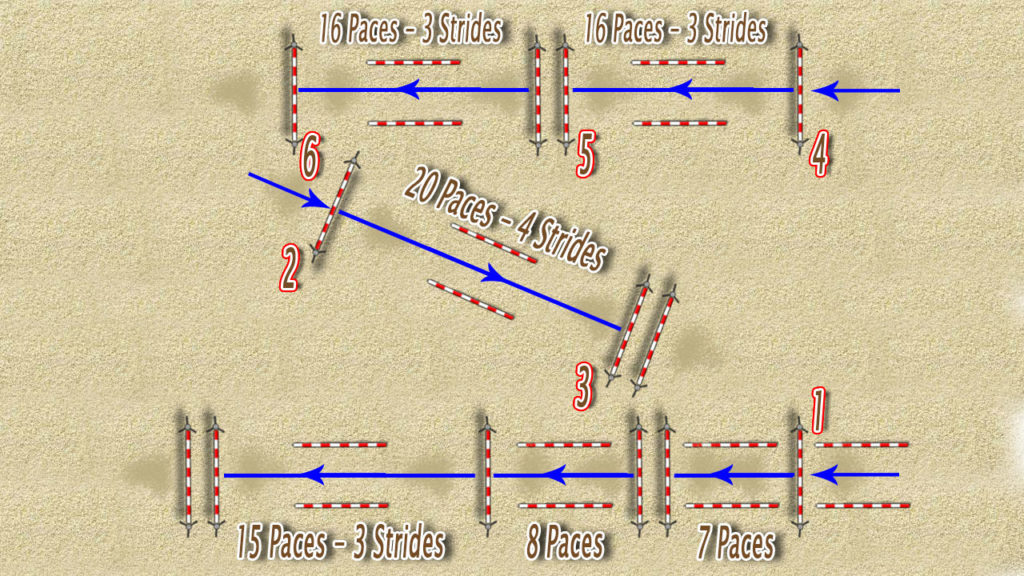
Line 1 — Bottom Long Side of the Arena
Start by setting up a line along the bottom long side of your arena:
- From the first vertical to the first oxer, measure 7 paces for a one-stride distance.
- From the first oxer to the second vertical, measure 8 paces for a one-stride distance.
- From the second vertical to the second oxer, measure 15 paces for a three-stride distance.
Next, place tramlines (poles on the ground) to help your horse stay straight:
- One set at the entrance to the gymnastic line.
- One set for each related distance.
Important: Keep the tramlines at least 2 meters apart to avoid any risk of your horse landing on them. Never set them closer than 1.5 meters apart. A single pole on either side of your horse is enough to help with straightness.
Line 2 — Diagonal Across the Arena
Set up a line on a diagonal:
- A vertical to an oxer, measuring 20 paces for a four-stride related distance.
- Add tramlines in the middle of this line.
Line 3 — Top Long Side of the Arena
Finally, along the top long side:
- Vertical to oxer, 16 paces for three strides.
- Oxer to vertical, another 16 paces for three strides.
- Place tramlines on both related distances.
And that’s it — you’re ready to ride!