Horse jump training
Horse jump training to tune up your related distances.
In this horse jump training exercise, we’re focusing on adjustability and control by playing around with the distances between jumps. At home, it’s easy to get comfortable riding standard, familiar distances. But when you get to a show, course builders often set lines that feel a little long or a little short compared to what you’re used to. That’s why it’s so important to practice these variations at home.
In this exercise, we simply adjust the related distances by adding or removing a pace here and there. It’s not about making the course difficult — it’s about teaching both horse and rider to adapt. By training this way, you prepare for the types of irregular lines and distances you’ll likely encounter at shows.
This type of horse jump training not only sharpens your eye for a stride but also builds obedience and adjustability in your horse. A good showjumper needs to respond when asked to lengthen or shorten their stride, especially in technical combinations or tricky lines. The more you practice this at home, the more confident and capable you and your horse will feel in the show arena.
It’s easy to overlook this kind of preparation, but riders who consistently work on adjustability are far less likely to get caught out by unexpected distances at a competition. Try this exercise and give yourself — and your horse — the skills to handle any course designer’s challenge with confidence.
How to set this exercise up
This setup isn’t complicated, but we’re adjusting the distances a little in this exercise, so the measurements aren’t completely standard. Just pay close attention when setting it up.
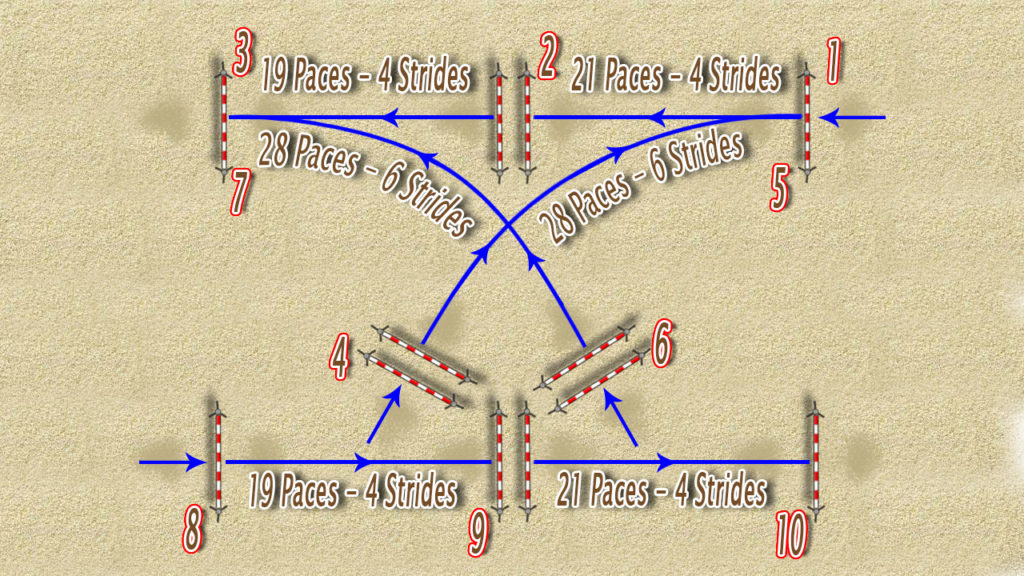
Top Long Side – Jumps 1, 2, and 3
Start with the line along the top long side of your arena:
- A vertical, followed by four long strides to an oxer.
- Then four short strides to a vertical.
- The distance from the first vertical to the oxer is 21 paces.
- The distance from the oxer to the second vertical is 19 paces.
Bottom Long Side – Jumps 8, 9, and 10
Next, set up a similar line along the bottom long side, but with slightly different distances:
- A vertical, followed by four short strides to an oxer (19 paces).
- Then four long strides to another vertical (21 paces).
Curved Lines – Jumps 4 and 6
- From the vertical at the end of the first line, measure 28 paces on a curve and set up an oxer — this gives you a six-stride related distance on a curve.
- Mirror this on the opposite side of the arena: from the first vertical in the second line, measure 28 paces on a curve to another oxer, also for a six-stride related distance.
And that’s it — your course is ready! Take your time to double-check the measurements, and you’ll be set up and ready to ride.